

Tennis Match Betting Is Different From Every Other Sport — Here’s Why
In team sports, rosters absorb individual variance. One player has a bad day — the team still competes. In tennis match betting, one player is the entire team. One bad knee, one mental block, one surface mismatch — and a heavy favorite loses in straight sets.
That volatility is both the challenge and the opportunity. Tennis match betting markets price players primarily on ranking and recent results. They underweight surface-specific form, fatigue patterns, scheduling context, and stylistic matchup dynamics. That gap between market pricing and true probability is where sharp bettors consistently find edge.
The ATP and WTA tours produce matches every single day. That volume is what makes tennis such an attractive betting market — and what makes it dangerous for anyone without a clear tennis betting system in place.
The calendar runs from January to November. Grand Slams, Masters 1000s, ATP 500s, Challengers — each level carries different player motivation, different preparation intensity, and different odds accuracy. Tennis match betting requires understanding not just who the better player is, but whether they care about this particular match right now.
The 10 Things You Must Know Before Placing a Tennis Match Bet
1. Surface is the single most important variable. Surface is the single most important factor in tennis betting, and the one most bettors underweight. Clay, grass, and hard courts produce different outcomes for different player profiles. A baseline grinder dominates clay and struggles on grass. A big server thrives on fast surfaces and underperforms on slow ones. Always check surface-specific win rates — not just overall rankings.
2. Head-to-head records matter — but not blindly. H2H history is a useful context. It’s not gospel. Tennis is a sport where matchup plays a decisive role in the outcome of a match. Each player has their own playing style, strengths, and weaknesses — and if A beats B and B beats C, it doesn’t automatically mean A beats C. Filter H2H records by surface to find the pattern that actually matters.
3. Fatigue and schedule context are chronically underpriced. Consider the player’s recent schedule. A well-rested player might have an advantage over someone coming off multiple strenuous matches. Back-to-back tournament weeks, travel across time zones, and five-set marathon matches from the previous round all compound fatigue. The odds rarely move enough to account for it.
4. Moneyline is the foundation of tennis match betting. Unlike many team sports where betting on the point spread is the most common wager, the moneyline is the preferred — and by far the most popular — bet type in tennis betting. Pick the winner. Simple structure, deep strategy.
5. Handicap betting levels the playing field on mismatches. When a top-10 player faces a qualifier, the moneyline offers brutal juice. In tennis, spreads are in games won rather than points — a top player may be favored by 6.5 games over a lesser opponent. Taking the underdog at +4.5 or +5.5 games offers better value than backing them straight up.
6. Left-handed players create consistent matchup inefficiencies. Matches that involve left-handed players are usually a tough matchup for all players since they are more used to playing right-handed opponents. When betting on a match that involves a left-hander, look at the right-handed player’s record against these types of opponents.
7. Big servers distort set totals in predictable ways. Players with elite first serves rely heavily on the dominance of their own service game, and they often have weak return games — which props up the other player’s service game too. Tiebreakers become highly likely. First-set over bets gain value in matchups between two big servers.
8. Player motivation shifts throughout the season. A player who needs ranking points to qualify for the year-end Masters tournament will not play the same way in a quarterfinal as one who is already locked in. Late in the season, players who have secured their goals sometimes skip lower-priority events or underperform to rest before the next major. These behavioral patterns are systematic, and the odds rarely account for them.
9. Returning from injury creates exploitable pricing. A player returning from injury in their first tournament back is almost always under-priced as an underdog — not because they’ll necessarily lose, but because the market tends to price them at their pre-injury ranking rather than their current match sharpness.
10. Line shop aggressively — gaps between books are wide in tennis. Line shopping across multiple books can significantly increase profitability over time. Tennis match betting lines vary more across books than NFL or NBA markets because the liquidity is lower. A 30 to 50-point difference on an underdog is common. Never lock in a price without checking at least three books.
Live Tennis Match Betting: Where the Real Edge Lives
Pre-match tennis betting is efficient. Live tennis match betting is not. That inefficiency is deliberate — and exploitable.
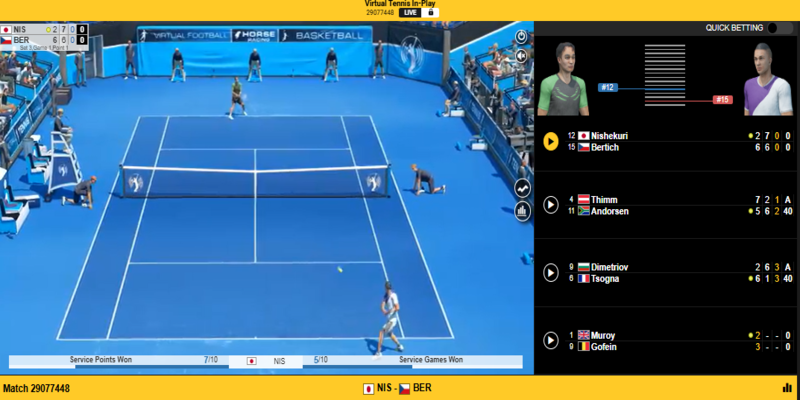
The most reliable pattern: a strong favorite who drops the first set is systematically over-valued as an underdog going into the second set. Markets often overcorrect, offering better odds on the favorite than are warranted by their actual win probability from that point. Betting the favorite after they drop an opening set — particularly on a fast surface where breaks are rarer and comebacks more common — is one of the most consistent live betting approaches in tennis.
Building a Repeatable Tennis Match Betting Process That Holds Up
One-off insights don’t build profit. A repeatable process does.
Before every tennis match bet, run this checklist:
Surface check. What is each player’s win rate on this surface in the last 12 months? Not overall — surface-specific.
Schedule check. How many matches has each player played in the last seven days? How many five-set matches? How far did they travel between events?
Motivation check. What does this tournament mean to each player right now? Ranking protection, seeding, qualification targets — all of these shape effort levels in ways the odds don’t capture.
Line comparison. Check at least three books before placing. Log the odds you got and the closing odds at a sharp market after the match. Track closing line value on every tennis match bet over time.
Market selection. Is the moneyline the best vehicle for this specific read, or does set betting, handicap, or a live position offer better expected value for the same underlying opinion?
Conclusion
Tennis match betting is one of the most edge-rich markets in sports wagering — precisely because the volume is enormous, the outcomes are individual, and the market consistently misprices surface form, fatigue, motivation, and stylistic matchups. The 10 factors in this list that Moneyline.fyi mentioned aren’t tips to memorize. They’re filters to build into every pre-match analysis.