
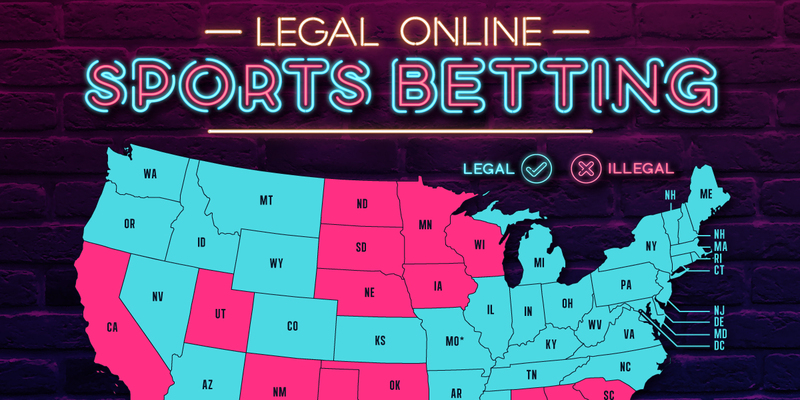
How the US Legal Betting States Map Was Created — The PASPA Ruling Explained
Before 2018, sports betting was essentially illegal in the United States. One federal law — the Professional and Amateur Sports Protection Act, known as PASPA — blocked states from authorizing it. Nevada was the only exception.
That changed on May 14, 2018. The Supreme Court ruled PASPA unconstitutional in the Murphy v. NCAA case. The decision handed regulatory power directly to individual states. Each state could now decide for itself whether to legalize, regulate, and tax sports betting within its borders.
The floodgates opened fast. When the U.S. Supreme Court lifted the federal ban on sports gambling in 2018, brick and mortar casinos, sports fantasy apps, and other operators were quick to expand their operations to make online sports betting part of their offering.
New Jersey was first to go live online — placing the first legal bet on August 1, 2018. Iowa and Indiana followed in 2019. The number of US legal betting states grew quickly in the years after the Supreme Court ruling.
Seven years later, the map has transformed. What started with one state has become a majority of the country with active, competitive sports betting markets.
US Legal Betting States Right Now: Online, Retail-Only, and Tribal Markets
Not all US legal betting states are equal. Moneyline.fyi shows you three distinct categories — and the difference between them matters significantly to bettors.
Statewide Online/Mobile is the gold standard. You download an app, verify your location inside state lines, and bet from anywhere in the state. This is available in the most active markets.
Retail-Only or On-Premise Mobile means you must physically visit a casino or licensed location to bet. Mississippi is the clearest example — Mississippi permits sports betting only at physical casino locations. While efforts to legalize statewide online sports betting have been ongoing, the 2024 legislative deadline has passed.
Currently 30 states have online betting via smartphone apps or websites. D.C. and Puerto Rico also allow online betting.
The gap between “legal in some form” and “full statewide mobile access” is the most important distinction bettors need to understand before assuming they can bet freely in any given state.
The Biggest US Legal Betting States by Market Size and Revenue
Not all US legal betting states generate the same volume. Market size varies enormously based on population, tax structure, and number of licensed operators.
New York is the dominant market. In the 2024–25 fiscal year, New York reported a sports betting handle of $23.94 billion, generating $2.14 billion in gross gaming revenue and over $1 billion in tax revenue — marking the first time a U.S. state surpassed the $1 billion mark in annual sports betting tax collections.
New Jersey is the second-largest market. In 2024, New Jersey’s sports betting handle reached $12.77 billion, with gross gaming revenue of $1.09 billion, resulting in approximately $156 million in tax revenue. New Jersey was the state that challenged PASPA and opened the door for all others — its market reflects that pioneering position.
Illinois, Pennsylvania, and Michigan round out the top tier of US legal betting states. All three have fully online markets, double-digit sportsbook counts, and large betting handles driven by major professional sports fan bases.
The tax rate differences between states are significant for bettors indirectly. Higher tax states — New York taxes operators at 51% — mean tighter odds and fewer promotions. Lower tax states produce more competitive markets with better pricing.
States Still Holding Out — and Why Legalization Remains Stalled
A meaningful group of states remains outside the US legal betting states club — and each has a different reason for staying out.
California is the biggest missing market in the country. Multiple bills to legalize sports betting in California have failed, including two major bills on the November 2022 ballot. Two California ballot measures in November 2022 each received less than 20% voter support. No new legislation was introduced in 2025. Tribal gaming interests hold significant influence over California’s path to legalization, and no near-term launch appears likely.
Texas is the second-largest state by population with no legal betting. Lt. Gov. Dan Patrick controls the Senate agenda and opposes gambling. House conservatives estimate they’re short 15+ votes. Advocates have pivoted to the 2027 regular session or a possible 2026 special session.
Alabama, Alaska, California, Georgia, Hawaii, Idaho, Minnesota, Oklahoma, South Carolina, Texas, and Utah are states where there is currently no sports betting.
What the US Legal Betting States Landscape Looks Like Going Forward
The US legal betting states map will keep expanding. The pace has slowed — the easiest states to legalize already have — but several large markets remain within reach.
Georgia is the most likely near-term addition. The legislative momentum, while imperfect, is the strongest it has ever been. A Georgia launch would add one of the top-10 most populated states to the US legal betting states roster.
Texas and California remain the long-term prizes. Combined, they represent roughly 20% of the US population with no legal access to regulated sports betting. California’s tribal gaming politics make any near-term timeline unlikely. Texas requires a constitutional amendment that faces deeply entrenched opposition.
Federal regulation remains a background conversation. The SAFE Bet Act was introduced in September 2024 and addresses affordability, advertising, and AI in the industry — it would also ban prop betting on college sports. Federal intervention at this level is unlikely to pass quickly, but it signals growing congressional attention to the industry.
The current US legal betting states landscape represents a market that has grown from one state to nearly 40 in seven years. The remaining holdouts are harder to crack — politically, constitutionally, or culturally. But the direction of travel is clear.
Conclusion
The US legal betting states map in 2026 reflects a remarkable seven-year transformation. From a single state exemption under PASPA to nearly 40 states with regulated markets, the rollout has been faster and more widespread than most analysts predicted. For bettors, the most important distinction remains online versus retail access — being in a “legal state” doesn’t always mean you can bet from your phone.