
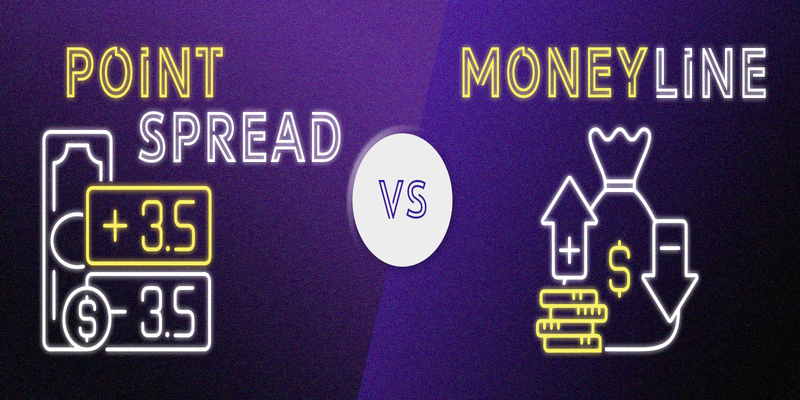
Moneyline vs Spread: Two Ways to Bet, Two Different Games
When you’re new to sports betting, the first fork in the road usually looks like this: do you bet the moneyline or the spread? Moneyline vs pread – what is the difference?
They’re the two most common bet types in U.S. sports betting. Both involve picking a winner — sort of. But the mechanics are different enough that choosing the wrong one for the wrong situation can quietly cost you money over time.
The moneyline is the simpler of the two. You pick who wins. That’s it. No margin, no cushion. Your team wins, you get paid. Your team loses, you lose the bet.
The point spread adds a layer. The favorite has to win by more than a set number of points. The underdog can lose — as long as they lose by less than that number. Both sides end up priced close to even odds, usually around -110.
Those two sentences capture the core of moneyline vs spread. But the real question isn’t what they are. It’s when each one makes sense.
What the Moneyline Is Actually Asking You to Do
A moneyline bet is a pure confidence bet. You’re saying: I believe this team wins this game. Full stop.
The tradeoff is in the price. When one side is heavily favored, the moneyline gets expensive fast. A -300 favorite means you’re risking $300 to profit $100. The team probably wins — but at that price, a single upset wipes out three previous wins.
On the flip side, betting underdogs on the moneyline can be high-reward. A +250 dog wins you $250 on a $100 bet. You don’t need them to win often — just often enough to overcome the implied probability built into those odds.
That’s the core calculation for any moneyline bet: does my estimate of the team’s win probability exceed what the odds imply? If you think a team has a 55% chance of winning but the moneyline prices them at 48% implied probability, there’s value. If the numbers match or go the wrong way, there’s no edge.
Moneyline vs spread betting works best when the game is genuinely hard to predict by margin, like baseball, hockey, or soccer. In low-scoring sports, spreads become less relevant. A one-run or one-goal margin is hard to handicap precisely. The moneyline cuts through that noise.
How the Point Spread Changes the Way You Think About a Game
The point spread doesn’t ask “who wins?” It asks “by how much?”
That reframing changes everything. A spread bettor isn’t just analyzing which team is better. They’re analyzing whether the better team is better by enough. That’s a harder question — and a more nuanced one.
In NFL betting, the spread might be Patriots -6.5. New England needs to win by 7 or more. If they win by exactly 6, spread bettors on New England lose. Moneyline bettors on New England win.
This is one of the most important practical differences in the moneyline vs spread debate. A team can win the game and still lose you a spread bet.
The advantage of the spread is that it levels the payout structure. Both sides come in near -110, which means the vig is more predictable and easier to account for in your long-term math. You’re not forced to risk huge amounts on heavy favorites just to chase a win.
Spread betting also rewards a particular kind of research. Line movement matters enormously. If the spread opens at -3 and moves to -5 by game day, that tells you something — either sharp money came in, or public betting pushed it. Understanding why lines move is a skill that pays dividends, specifically in spread betting.
When Moneyline vs Spread Comes Down to the Sport Itself
Not every sport is equally suited to both bet types. The moneyline vs spread decision often gets resolved at the sport level before you even look at a specific game.
NFL and college football — spreads are king. High-scoring, lots of variance in margin, clearly defined favorites and underdogs. The spread is the default bet for most serious football bettors.
NBA — both are viable, but the spread is more common. Blowouts happen regularly, so the moneyline on heavy favorites gets extremely expensive and the payout rarely justifies the risk.
MLB — moneyline dominates. There’s no standard run line equivalent in common use. Baseball games are low-scoring and often decided by one or two runs, making the moneyline a natural fit. Run line bets (similar to a spread) exist, but they’re less popular.
NHL — same logic as baseball. Puck line bets (the hockey equivalent of a spread at ±1.5 goals) exist, but the moneyline is the more popular format.
Soccer (MLS, EPL) — three-way moneylines are standard, which introduces a draw as a possible outcome. Spreads don’t translate well here.
The pattern is clear: the more scoring variance in a sport, the more the spread adds useful information. The lower-scoring the sport, the more the moneyline makes sense.
Choosing Between Moneyline and Spread Based on the Situation
There’s no universal answer in the moneyline vs spread debate. But there are clear rules of thumb that help you decide.
Bet the moneyline when:
- You have strong conviction that a team wins but the margin is uncertain
- You’re betting a low-scoring sport like baseball or hockey
- The spread feels like a coin flip but the winner seems obvious
- An underdog’s chances are undervalued — the payout justifies the risk
Bet the spread when:
- You expect a dominant performance but want a more balanced payout
- You’ve identified line movement suggesting mispriced odds
- The game is high-scoring with meaningful margin variance
- Both teams are roughly equal — the spread gives you a cleaner handicap
Tools like the betting calculators on the Moneyline.fyi help you run that math quickly — converting odds to implied probability, comparing payouts, and stress-testing whether a bet actually carries value before you place it.
The Bottom Line: Moneyline vs Spread Is a Strategic Decision
Neither bet type is inherently better. The moneyline vs spread question is really a question of fit — fit for the sport, the game, your analysis, and your bankroll.
Master how each one works. Know what each is actually pricing. Then use that knowledge to pick the format that gives your edge the best chance to show up.
Bet the type that matches your read on the game. That’s how the decision gets made.