
The Real Purpose of Betting Odds Goes Beyond Picking Winners
Most beginners look at betting odds explained and think one thing: who’s going to win? That’s the wrong starting point. Let’s Moneyline help you find the right way to approach great betting odds.
Betting odds serve two purposes at once. First, they tell you how much you’ll get paid if your bet wins. Second — and this is the part most people miss — they reflect how likely the sportsbook thinks an outcome is.
That second function is everything. Once you understand that odds are essentially a probability estimate dressed up as a payout ratio, your entire approach to sports betting shifts.
Say a team is listed at -200 on the moneyline. That’s not just saying “bet $200 to win $100.” It’s saying the book believes this team has roughly a 67% chance of winning. Now your job isn’t just to pick the winner — it’s to decide whether you agree with that 67%.
That’s the core of betting odds explained properly. Not the math alone. The thinking behind the math.
Betting Odds Explained – How American, Decimal, and Fractional Odds Actually Differ
There are three main formats you’ll encounter. They all communicate the same information — they just package it differently.
American odds are the default in the U.S. They work on a $100 baseline. A negative number (like -150) shows how much you must risk to win $100. A positive number (like +130) shows how much you win on a $100 bet. Simple once you get the rhythm.
Decimal odds are used heavily in Europe and Australia. They already include your original stake. Odds of 2.50 mean a $10 bet returns $25 total — $15 profit plus your $10 back. To find your profit, just subtract 1: (2.50 − 1) × stake.
Fractional odds are the traditional British format. 5/2 means for every $2 you risk, you profit $5. They look a bit old-fashioned, but you’ll still see them on horse racing boards.
Here’s why this betting odds explained matters: the same game can look very different depending on which format a site shows. A +200 American line is 3.00 in decimal and 2/1 fractional. Knowing how to convert between formats means you can shop lines across global sportsbooks — which is one of the fastest ways to improve your long-term results.
Quick conversion cheat sheet:
- American (+) to decimal: (odds / 100) + 1
- American (−) to decimal: (100 / |odds|) + 1
- Decimal to implied probability: 1 / decimal odds × 100
Implied Probability Is Where Betting Odds Get Interesting
Every set of odds contains a hidden number called implied probability. It’s the sportsbook’s estimate of how likely an outcome is — translated into percentage form.
Here’s how to calculate it:
- For negative American odds: |odds| ÷ (|odds| + 100) × 100
- For positive American odds: 100 ÷ (odds + 100) × 100
So if the Chiefs are -180 favorites, the implied probability is: 180 ÷ (180 + 100) = 64.3%.
Now here’s the critical part. If you add up the implied probabilities for both sides of a game, you won’t get 100%. You’ll usually get something like 104% or 105%. That extra percentage is called the vig (or juice or overround). It’s how sportsbooks make money regardless of the outcome.
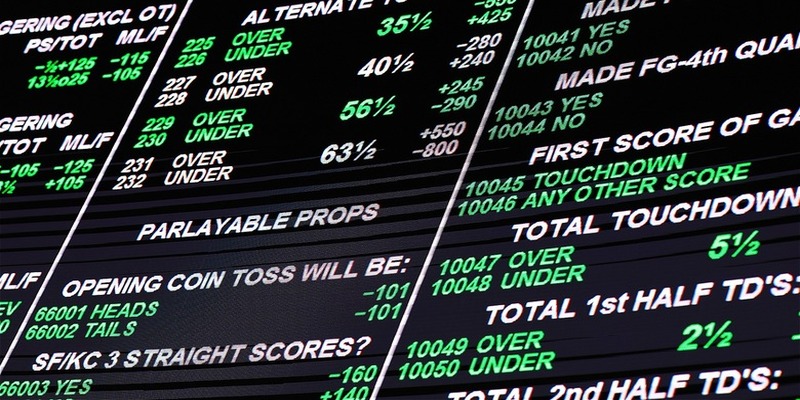
This means for any bet to have long-term value, your personal estimate of the probability must exceed the implied probability built into the odds. That gap — when it exists in your favor — is called positive expected value (+EV). Finding it consistently is what separates recreational bettors from profitable ones.
If you think Team A has a 60% chance of winning but the odds only imply 52%, you’ve found an edge. That’s what you’re hunting for every time you open a betting slip.
Reading Point Spreads and Totals Through an Odds Lens – Betting Odds Explained
Moneyline bets get the most attention when it comes to betting odds explained — but point spreads, and totals (over/unders) work on odds logic too.
Most spread bets are priced at -110 on both sides. That’s a standard vig. It means you’re laying $110 to win $100. But not all spreads are priced equally. Sometimes you’ll see -105 or -115. That difference matters over hundreds of bets.
Totals work the same way. The book sets a number — say 47.5 points for an NFL game — and you bet over or under. Both sides are usually priced near -110, but line movement can shift that quickly.
Half-points matter too. The difference between -3 and -3.5 in NFL betting is enormous. A 3-point favorite covers on the full number at -3 but loses at -3.5. Understanding why certain numbers carry more weight — called key numbers — is part of reading the odds landscape correctly.
Using Betting Odds to Build a Smarter Wagering Approach
The information give players is the foundation. Using them well is the practice.
Start by picking one format and getting fluent in it. Most serious bettors in the U.S. stick with American odds, but those who bet across markets often prefer decimal odds because the math is cleaner. Use a tool — like the calculators on Moneyline.fyi — to convert automatically until the mental math becomes natural.
Next, track implied probability before you track payouts. When you see a line, your first question should be: “What does this say the probability is?” Then ask: “Do I agree?” If your assessment is close to the book’s, there’s no edge. Move on. If you see a meaningful gap, that’s where a bet might make sense.
Shop for the best lines across multiple sportsbooks. Even small differences compound significantly. Getting +115 instead of +105 on the same bet over 50 wagers is a real dollar difference.
The Bottom Line on Betting Odds Explained
Betting odds explained simply: they’re a language. Like any language, fluency takes time.
Start with the basics. Get the math automatic. Then focus on finding spots where the sportsbook’s estimate of probability and your own estimate don’t match. That gap is where value lives — and value is the only thing worth betting on.