
Hedging a Bet: The Basic Concept Most Bettors Misunderstand
Hedging a bet means placing a second wager on the opposite side of your original bet — after circumstances have changed in your favor. The goal is to either guarantee profit regardless of the outcome or reduce the potential loss on the original ticket.
Hedging a bet is not the same as arbitrage. Arbitrage is calculated before a bet is placed — you build in both sides from the start. Hedging is reactive. You placed one side first. Conditions changed. Now you’re managing the position.
That timing distinction matters. And the decision of whether to hedge — and for how much — requires actual math, not just a feeling that the game is getting too close for comfort.
The Three Situations Where Hedging a Bet Actually Makes Sense
Not every bet deserves a hedge. Hedging a bet has a real cost — you’re sacrificing upside to reduce risk. Here are the three situations where that tradeoff genuinely makes sense.
Situation 1: You’re holding a live futures ticket
This is the most common scenario. You placed a futures bet on a team to win the championship at the start of the season — say, +800. They’ve made the finals. Now they’re -130 favorites to win the title.
Hedging here means betting the opponent in the final. If you size the hedge correctly, you win money regardless of who lifts the trophy. The original +800 long-shot ticket has turned into a guaranteed profit position. This is the cleanest application of hedging a bet — and one where the math almost always favors at least a partial hedge.
Situation 2: A parlay is one leg away from hitting
You have a six-leg parlay. Five legs have cashed. The final game is tonight. The parlay pays $1,200 on a $50 stake. The last team is now a slight underdog.
Hedging the last leg means betting the other side of that final game at your regular sportsbook. If the parlay hits, you win $1,200 minus the hedge stake. If the last leg loses, the hedge bet wins — and you recover some or all of your $50 original stake plus collect on the hedge.
The calculation determines whether full hedging, partial hedging, or no hedge is optimal. That depends on the hedge odds and how much of the parlay payout you’re willing to sacrifice for certainty.
Situation 3: Your original position is at risk and odds have shifted
You bet a pre-game moneyline at +200. Now, in-play, the team is down two scores with ten minutes left. The live odds on the other side are -180. Hedging here reduces your loss rather than locking in profit.
This is risk reduction hedging — not profit locking. It’s a different calculation and a different motivation. Whether it makes sense depends on your read of the live game and how much loss reduction is worth giving up the remaining chance of a full win.
How to Calculate the Right Hedge Stake
Hedging a bet without doing the math first is just guessing. Here’s the calculation framework.
For guaranteed profit (full hedge):
You want to find the hedge stake where both outcomes produce the same net result — profit on both sides.
Formula: Hedge stake = (Original stake × Original odds payout) ÷ (Hedge odds payout + 1)
Example:
- Original bet: $100 at +800 → potential payout $900 (profit $800)
- Hedge odds available: -150 → for every $150 risked, profit $100
Hedge stake = $900 ÷ (1 + 1/1.5) = approximately $360
If the original wins: $800 profit − $360 hedge stake = $440 net If the hedge wins: $360 × (100/150) = $240 profit − $100 original stake = $140 net
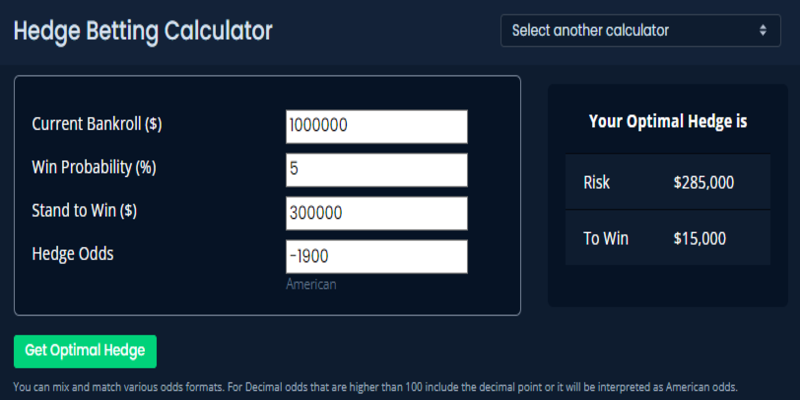
The exact numbers shift with different odds, but the principle holds. Use the hedge calculator at Moneyline.fyi to run these numbers instantly before deciding — manual calculation under pressure leads to errors.
For partial hedging:
You don’t have to cover both sides equally. A partial hedge reduces downside while preserving more upside on the original ticket.
If the parlay pays $1,200 and you want to guarantee at least $400 profit regardless, calculate what hedge stake produces $400 on the losing scenario, then check what you net on the winning scenario. That’s your partial hedge threshold.
The decision between full and partial hedging is ultimately a risk tolerance question. Full hedging prioritizes certainty. Partial hedging accepts some outcome variance in exchange for a larger potential return if the original bet hits.
The Hidden Cost of Hedging a Bet: What You’re Actually Giving Up
Hedging a bet always has a price. Most bettors feel it intuitively but rarely calculate it explicitly.
When you hedge a futures ticket that’s now priced at -130 for a team you backed at +800, you’re placing a negative expected value bet on the hedge side. The -130 price includes vig. You’re paying the sportsbook again to reduce your risk.
Over time, compulsive hedging destroys ROI. Every hedge bet placed at juice-inflated prices eats into the positive expected value of your original position. If you consistently hedge every bet that moves in your favor before it resolves, you’re effectively capping your upside while still absorbing losses when early bets go wrong.
The bettors who hedge profitably do it selectively. They hedge when:
- The guaranteed profit is substantial relative to the original stake
- The live odds are close to fair value — hedge vig is minimal
- The outcome variance is genuinely high and the locked profit is meaningful
Hedging a Bet vs. Letting It Ride: How to Make the Decision
The cleanest way to decide is to calculate the expected value of not hedging and compare it to the certain return of hedging.
If your original parlay has a 45% chance of winning and pays $1,200, the expected value of not hedging is: 0.45 × $1,200 − 0.55 × $50 = $540 − $27.50 = $512.50 expected value
If the full hedge locks in $400 regardless, the hedge is worth less in expected value terms — but eliminates all variance. Whether $400 certain beats $512.50 expected is a personal risk tolerance question, not a universal answer.
Use the hedge calculator at moneyline.fyi to run both scenarios before the game starts. When the numbers are in front of you, the decision is clearer — and less emotional.