

Implied Probability Is the Number Most Bettors Never Look For
Ask a casual bettor what -140 means and they’ll tell you: “risk $140 to win $100.” That’s correct. But it’s only half the answer.
Every betting line contains a second number. It doesn’t appear on the screen. You have to calculate it yourself. That number is the implied probability — the sportsbook’s estimate of how likely an outcome is, encoded directly into the price.
At -140, the number is 58.3%. The book says this outcome happens roughly 58 times out of 100. That’s not a payout figure. That’s a forecast.
Most bettors never look for it. That’s exactly why understanding implied probability is one of the clearest edges available to anyone willing to do the basic math. You don’t need advanced statistics. You need one formula and the habit of using it before every bet.
How to Calculate Implied Probability From Any Odds Format
The calculation changes slightly depending on the odds format you’re working with. Here’s how to handle all three.
American odds (negative): Formula: |odds| ÷ (|odds| + 100) × 100
Example: -180 → 180 ÷ (180 + 100) × 100 = 64.3%
American odds (positive): Formula: 100 ÷ (odds + 100) × 100
Example: +145 → 100 ÷ (145 + 100) × 100 = 40.8%
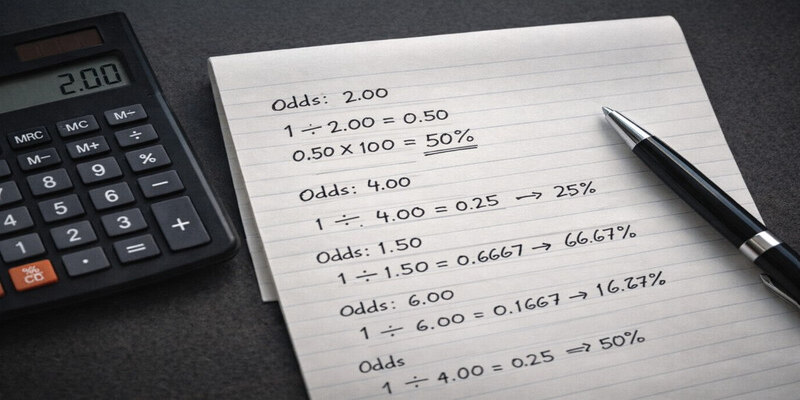
Decimal odds: Formula: 1 ÷ decimal odds × 100
Example: 1.75 → 1 ÷ 1.75 × 100 = 57.1%
Fractional odds: Formula: denominator ÷ (numerator + denominator) × 100
Example: 3/1 → 1 ÷ (3 + 1) × 100 = 25%
Run through these a few times, and the mental math becomes fast. Once you can estimate the number in your head — even roughly — you start reading lines differently.
Implied Probability Exposes the Vig Every Sportsbook Hides
Here’s where it gets interesting. Take any game. Calculate the number for both sides. Then add them together.
You won’t get 100%. You’ll get something like 104%, 105%, maybe 106% on some books. That excess percentage is the vig — also called the juice or overround. It’s how sportsbooks guarantee a profit regardless of the game’s outcome.
Example — NFL spread, standard -110 pricing both sides:
- Side A: -110 → implied probability = 52.4%
- Side B: -110 → implied probability = 52.4%
- Total: 104.8%
The 4.8% excess is the vig. It’s built into the price silently. No line item. No disclosure. It’s just there.
This matters for one reason: it sets your break-even threshold. To profit long-term at -110, you need to win at least 52.4% of your bets — not 50%. That extra 2.4% is the cost of doing business with a sportsbook.
When you shop for lower juice — say -105 instead of -110 — your break-even drops to 51.2%. That gap compounds significantly across a season. Implied probability math makes this visible. Without it, the vig is invisible and you’ll underestimate how often you actually need to win.
Using Implied Probability to Find Value Bets
This is the core application. This is why the concept matters beyond the math.
Value exists when your personal estimate of an outcome’s probability is higher than the number built into the odds. That gap — your number minus the book’s number — is the edge.
Simple example: You’ve studied a matchup. You believe Team A has a 60% chance of winning. The moneyline is priced at -135, which implies a probability of 57.4%. Your estimate (60%) exceeds the implied probability (57.4%). That’s a positive expected value bet.
Now flip it. Same team, same price, but after reviewing the injury report and recent form, you now think their win probability is closer to 53%. The number is still 57.4%. The book’s number is higher than yours. There’s no value here. You pass.
That’s the decision framework. Every bet runs through the same filter:
- Calculate the implied probability from the odds
- Estimate your own probability independently
- Compare the two numbers
- Bet only when your estimate meaningfully exceeds the implied probability
This process won’t make you right every time. No approach does. But it forces you to bet with a reason — a specific, quantified reason — rather than a gut feeling dressed up as analysis.
Making Implied Probability Part of Your Pre-Bet Routine
Knowing how to calculate implied probability is one thing. Building it into a consistent routine is what actually changes your results.
Before placing any bet, run through three checkpoints.
Checkpoint one: What is the implied probability? Pull out the formula and calculate it. Write it down if you have to. Make it a concrete number, not a vague sense of “they’re favored.”
Checkpoint two: What is my independent probability estimate? This is the harder part. Your estimate needs to come from actual analysis — recent form, matchup data, injury news, pace, weather for outdoor games. Not from who you want to win. Not from which team has the better logo.
Checkpoint three: Is the gap significant enough? A 1% difference isn’t meaningful — variance swamps it. You’re looking for a 4–6%+ gap before a bet earns consideration. The bigger and more justified the gap, the stronger the bet.
Tools like the implied probability calculator on moneyline.fyi automate step one instantly. Paste in any odds format — American, decimal, or fractional — and the calculator outputs the number and the vig in seconds. That removes the friction and keeps your focus on steps two and three, where the real thinking happens.
Conclusion: Implied Probability Is the Foundation of Smart Betting
Betting without checking implied probability is like shopping without checking prices. You might get lucky. But you’re not making an informed decision.
Once you start calculating it consistently, you’ll notice something: most of the bets you used to place don’t clear the filter. The number matches or exceeds your own estimate. There’s no edge. You pass.
That’s not a problem. That’s the process working correctly.
The bets that do clear the filter — where your probability estimate clearly exceeds what the odds imply — are the ones worth placing. Not because they’ll always win. But because they represent genuine value. And genuine value, bet consistently over time, is the only path to long-term profit in sports betting.